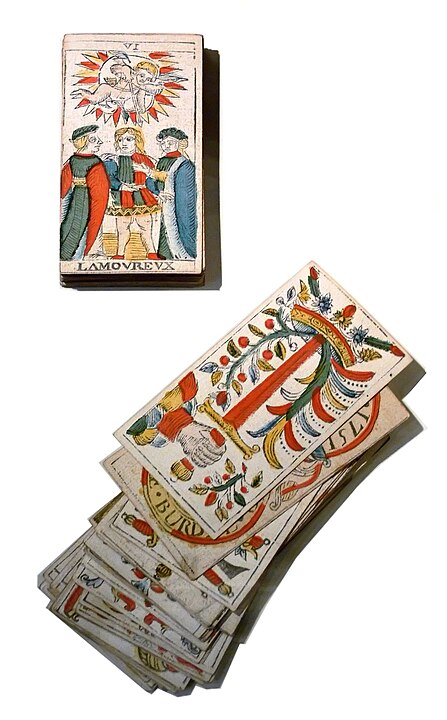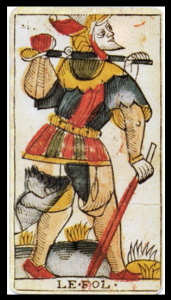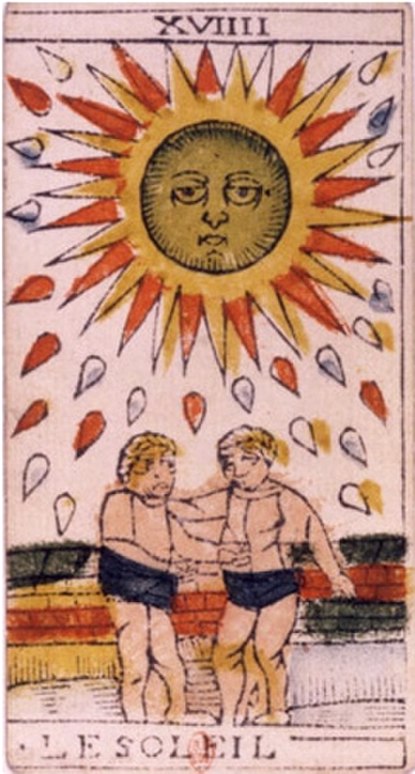
Tarot de Marseille, which were originally printed with woodblocks and then hand painted in the 17th century is often considered one of the first tarot decks.
Trionfi (Italian: [triˈoɱfi], ‘triumphs‘) are 15th-century Italian playing card trumps with allegorical content related to those used in tarocchi games. The cards were also referred to as “Triumphs” as it relates to pagentry and royal classes.
The earliest known use of the name “Trionfi” in relation to cards can be dated to 16 September 1440 in the records of a Florentine notary, Giusto Giusti.[2] He recorded a transaction where he transferred two expensive personalized decks to Sigismondo Pandolfo Malatesta.[3]
attribution: https://en.wikipedia.org/wiki/Trionfi_(cards)
The origins of the Tarot de Marseille, one of the oldest and most influential tarot decks, are rooted in the historical development of playing cards in Europe during the late Middle Ages and the Renaissance. While the exact origins are not definitively documented, there are several theories and historical clues that provide insights into the creation and evolution of the Tarot de Marseille.
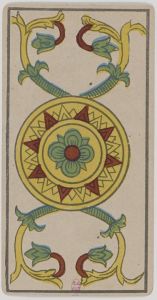
Playing cards began to appear in Europe around the late 13th century. These early playing cards included the standard suits we recognize today—swords, cups, coins, and batons (which later evolved into wands).
The earliest forms of tarot were primarily used as a card game, rather than for divination. The game was known by various names, such as “tarocchi” in Italy and “tarot” in France. It involved trick-taking gameplay similar to other card games of the time. The Tarot de Marseille is associated with the advent of woodblock printing technology in the 15th century. This technology allowed for the mass production of playing cards, including tarot (tarrochi) decks. The city of Marseille in France became a significant hub for card production.
Over time, some decks of playing cards began to incorporate additional illustrated cards, often depicting allegorical figures, biblical scenes, or mythological symbols. These extra cards eventually evolved into the tarot’s Major Arcana, which consists of 22 symbolic cards, but this didn’t appear until the late 1700’s when occultism became a niche and divination was introduced using cards.
While the Tarot de Marseille began as a card game, it gradually acquired esoteric and divinatory associations. Occultists and mystics, including Etteilla and Antoine Court de Gébelin, began to interpret the tarot cards as symbolic tools for spiritual insight and fortune-telling.
The art of the Tarot de Marseille appeared in the 17th and 18th centuries. The cards are characterized by bold, primary colors, simplified designs, and a focus on the figures and symbols. This style influenced many subsequent tarot decks.
The Tarot de Marseille served as a foundational template for later tarot decks, including the Rider-Waite Tarot and other modern interpretations. Its enduring influence on tarot tradition and symbolism is evident in its continued popularity among tarot enthusiasts and readers.
The origins of the Tarot de Marseille are closely tied to the evolution of playing cards in Europe, the emergence of woodblock printing technology, and the gradual development of tarot’s iconic symbolism. While its original purpose was as a card game, its transition to a tool for divination and spiritual insight laid the groundwork for the rich tapestry of tarot tradition that exists today.
The origins of the Tarot de Marseille, one of the oldest and most influential tarot decks, are rooted in the historical development of playing cards in Europe during the late Middle Ages and the Renaissance. While the exact origins are not definitively documented, there are several theories and historical clues that provide insights into the creation and evolution of the Tarot de Marseille.