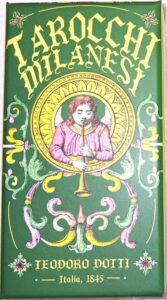
tarocchi milanesi box cover


A Review of the Tarocchi Milanesi by Teodoro Dotti, 1845

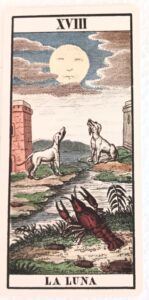
The Tarocchi Milanesi of Teodoro Dotti, dating to around 1845, presents classical artwork in this equisite reproduction. It belongs to the elegant Milanese tarot tradition that grew out of Ferdinando Gumppenberg’s celebrated Soprafino designs. Soprafino disigned his tarocci decks for royalty and wealthy patrons. Milanesi mostly refers to the regional area called Milan, in Italy.

Main differences between the two decks are:

  • Line Quality: The Soprafino used fine copperplate engraving, giving it very detailed, flowing, and graceful lines. Traditional Milanese decks derived from it often relied on slightly simpler or woodblock prints. 
  • Political/Sovereign Symbols: Later Milanese variants (such as the Dotti editions) altered details like the Empress’s shield—removing Hapsburg or imperial eagles due to changing 19th-century Italian politics.

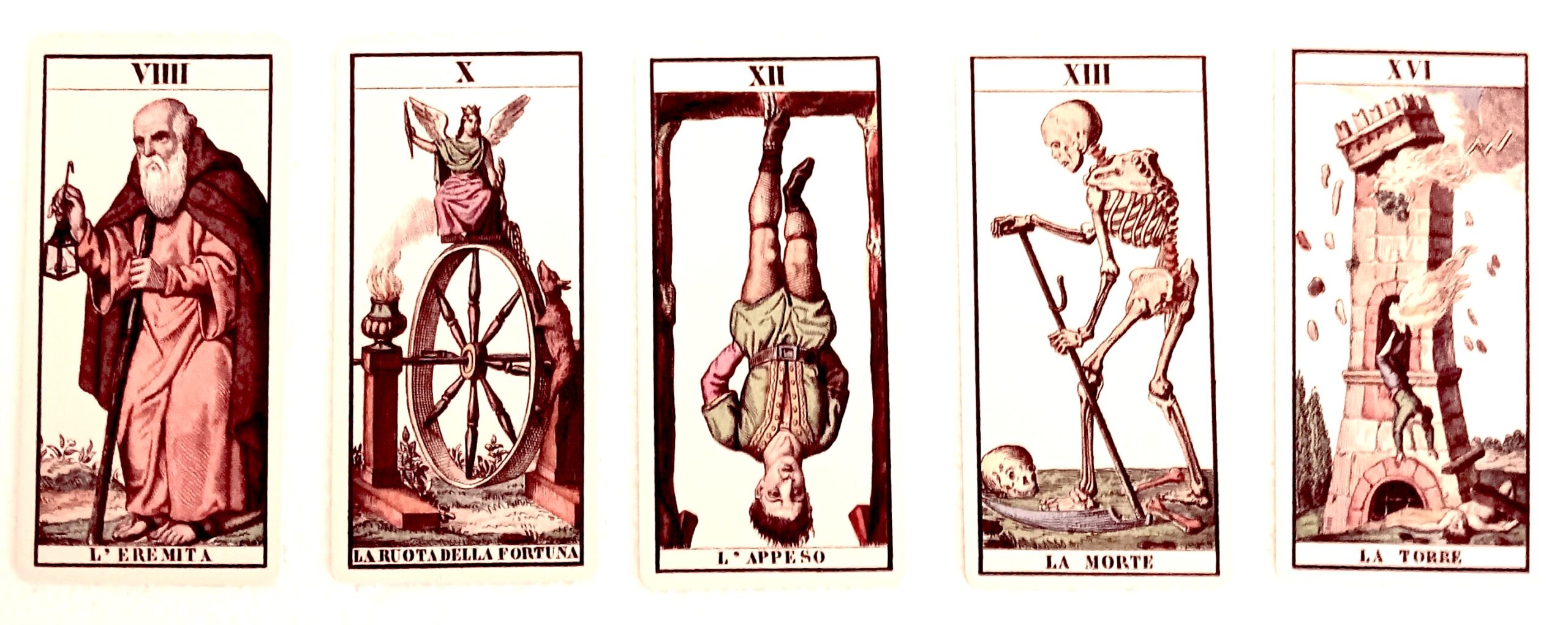
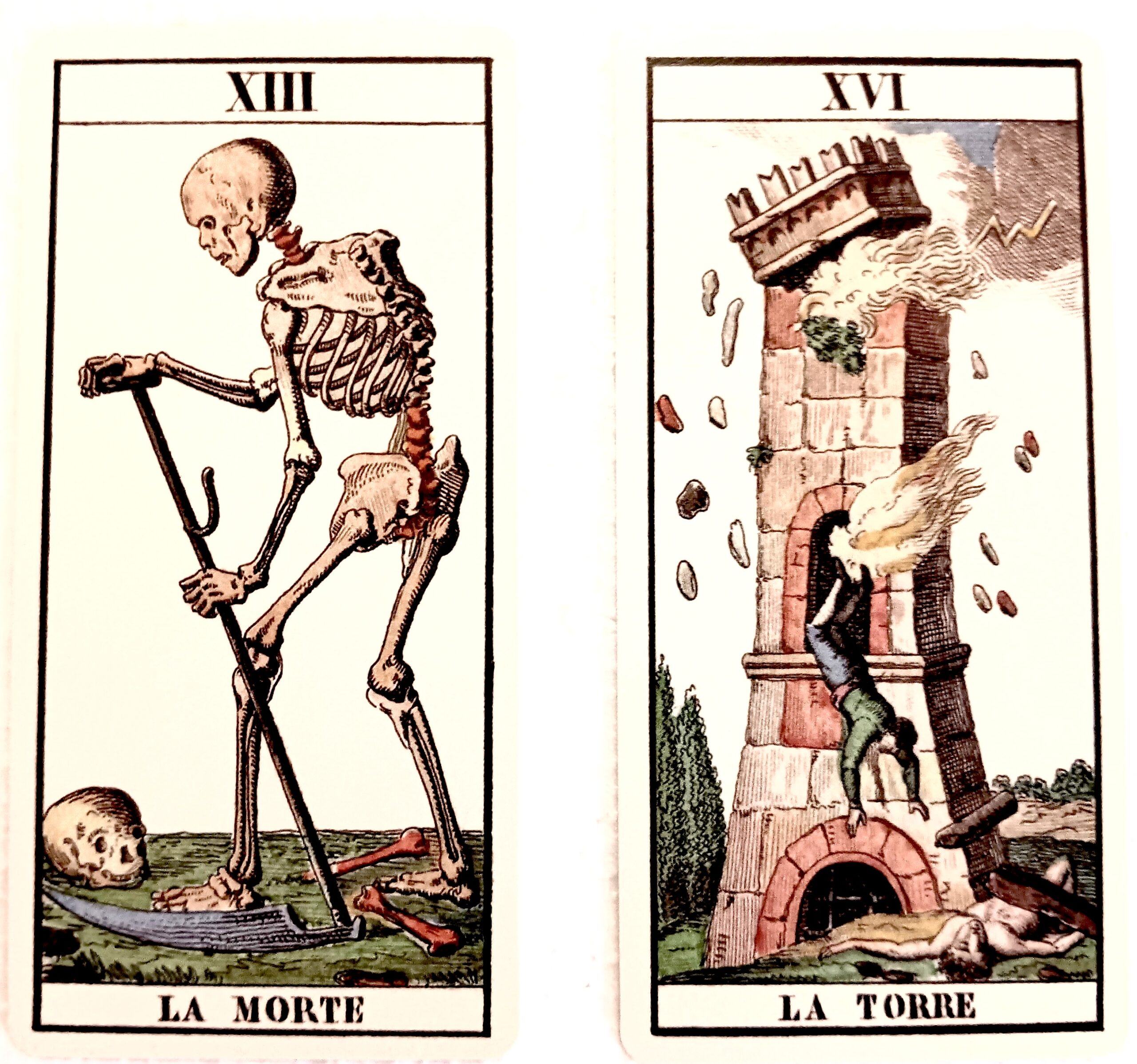
For both decks, the figures seem to inhabit a world that is simultaneously ordinary and symbolic—a world where the Fool’s journey, the Hermit’s solitude, the Wheel of Fortune, Death, and the Star feel less like abstract concepts and more like stages in an ancient human story. The imagery retains much of the traditional Tarot de Marseille structure while incorporating the refined Milanese aesthetic. 

How Many Cards did the Milanese Deck have?

The earliest versions of the Milanese decks sometimes featured an extra set of female court cards, temporarily bringing the total to 64 or more cards per pack before standardizing back to the traditional 56 suit cards. This of course was before the 22 Major Arcana cards were added.

An especially delightful historical connection is that William Butler Yeats owned a Dotti deck and wrote upright and reversed meanings on his cards—an intriguing reminder that these nineteenth-century images eventually found their way into the hands of one of the great poets of the twentieth century.

tarocchi milanesi spread of five cards
The fool marseille

Teodoro Dotti: Milanese Card Maker

For collectors, historians, and readers who enjoy tarot’s older visual traditions, the Dotti deck offers a beautiful doorway into nineteenth-century Milanese esotericism and artistic culture. It may not have the immediately familiar visual vocabulary of the Waite-Smith Tarot, but that is precisely its attraction. The Dotti Tarot feels like an old book discovered in an attic—quiet, elegant, slightly mysterious, and filled with symbolic doors waiting to be opened.

As far as the creator of this deck, little surviving biographical information about Teodoro Dotti himself exists, so claims about his personal motivations or how he first became interested in tarot should be treated cautiously. The historical record does establish his professional connection with Ferdinando Gumppenberg and his subsequent career as a Milanese card maker. 

Teodoro Dotti was a nineteenth-century Milanese card maker whose work became an important chapter in the history of Italian tarot. Sources place him in Milan’s thriving playing-card industry during the first half of the nineteenth century, where he became associated with the workshop of the influential printer and card maker Ferdinando Gumppenberg. Dotti is described as having been Gumppenberg’s employee, partner, or associate during the late 1830s and early 1840s. Around the 1840s, he established his own printing workshop, eventually becoming one of the leading card makers in Milan. ([Tarot Heritage][1])

There is unfortunately no reliable surviving account explaining **when or why Dotti personally became interested in tarot**. It is more historically accurate to say that tarot entered his professional life through Milan’s established card-making tradition. Gumppenberg had already produced the magnificent deck later known as the *Soprafino* around 1830–1835, and Dotti worked within this artistic and commercial environment before developing his own versions. When he established his independent workshop, Dotti commissioned new engraved plates rather than simply reproducing Gumppenberg’s originals. His celebrated *Tarocco Italiano* of approximately 1845 therefore represents both a continuation of the Milanese tradition and Dotti’s own artistic interpretation of it. ([Tarot Heritage][1])

Dotti’s contribution to tarot was ultimately much greater than simply producing another pack of playing cards. His designs softened and refined elements of the Soprafino tradition while bringing some imagery closer to the familiar visual language of the Tarot de Marseille. His workshop continued producing tarot and playing cards for decades, and his son Edoardo later carried the family tradition forward. Teodoro’s 1845 tarot has since become particularly prized by historians and collectors because it captures a fascinating moment when Milanese tarot was evolving between older Italian traditions and the increasingly influential Marseille vocabulary. Although we cannot know precisely what Dotti himself thought about tarot as a mystical or divinatory system, his beautiful cards became part of the visual heritage through which later generations would discover—and eventually reinterpret—the symbolic world of tarot. ([Tarot Heritage][1])
I deliberately avoided inventing a personal story about **Dotti’s supposed fascination with tarot**, because the surviving evidence doesn’t establish one. The most defensible story is that his interest was initially **professional and artistic**, arising from his involvement in Milan’s card-making trade and Gumppenberg’s influential tarot tradition.

### **Zhao Chen: Tarot Restorer, Collector, and Historian**

The Tarocchi Milanese of 1845, has been restored by Zhao Chen and arrived from China. Zhao Chen (赵晨) is a Chinese tarot researcher, collector, and restorer whose work is devoted particularly to the history and visual traditions of classical tarot. Rather than approaching tarot solely as a system of divination, Zhao has pursued it as an important form of European cultural and artistic history. His interests encompass historic playing cards, early tarot traditions, and especially the development of the Tarot de Marseille and related European patterns. According to a biographical introduction accompanying an interview with him, Zhao has collected more than 2,000 historical and classical card decks from around the world, reflecting an unusually extensive engagement with the material history of tarot.

A central part of Zhao’s work is the **restoration and reconstruction of historic tarot decks**. He has successfully restored or redrawn several significant historical designs, including examples associated with 1701, 1930, 1845, and 1658, as well as the Bacchus Tarot. His approach combines the eye of an art conservator with the curiosity of a historian: paper, printing techniques, coloration, line work, iconography, and the physical deterioration of old cards all become part of the investigation. In interviews, Zhao has discussed how to identify historically valuable decks, how restoration decisions are made, and why certain obscure or damaged decks deserve to be preserved. His work therefore helps bring otherwise inaccessible historical tarot imagery back into circulation for collectors and students of tarot.

Perhaps most interestingly, Zhao’s work represents a meeting point between **tarot scholarship, art conservation, and the living spiritual tradition of the cards**. His historical perspective emphasizes that tarot need not depend upon romantic stories of ancient Egypt or other legendary origins to possess mystery and significance. Instead, its fascination can be found in the very human history of the cards—the artists, printers, collectors, players, and readers who continually transformed them over the centuries. Through collecting, studying, and restoring these fragile objects, Zhao Chen contributes to the preservation of a visual language that might otherwise disappear. His work offers tarot enthusiasts an opportunity to encounter these cards not simply as fortune-telling tools, but as surviving fragments of European art, craftsmanship, symbolism, and cultural memory.

78 Cards Tarot Deck

Card size: 10.6cm x 5.2cm (original size) 4.17 inches x 2.05 inches

Made by 330g high quality casino paper

98 pages paper manual

Limited 1000 numbered decks worldwide

[1]: https://tarot-heritage.com/2025/10/13/soprafino-nineteenth-century-tarot-in-milan/?utm_source=chatgpt.com “Soprafino: Nineteenth-Century Tarot in Milan | Tarot Heritage”

[1]: https://spiritone.com/~filipas/Masquerade/Reviews/dotti.html?utm_source=chatgpt.com “Teodoro Dotti Tarocco Italiano | Spirit One”
[2]: https://tarot-heritage.com/2025/10/13/soprafino-nineteenth-century-tarot-in-milan/?utm_source=chatgpt.com “Soprafino: Nineteenth-Century Tarot in Milan | Tarot Heritage”
[3]: https://eno-tarot.blogspot.com/2013/04/tarocco-italiano-dotti.html?utm_source=chatgpt.com “Eno’s Tarots: Tarocco Italiano (Dotti)”

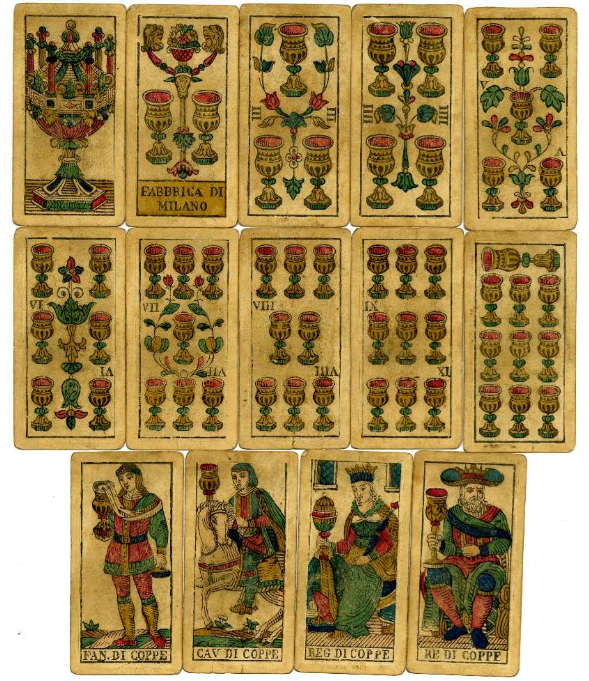
tarocchi milanese from the Brittish Museum collection
  • Hand-coloured woodcut
  • Backs printed in blue and yellow with ornamental panel
  • The word “Milano” also printed on the card backs
  • Production date approximately 1857-9 (circa)Published in: Milan, Italy
  • Printed on pasteboard
  • Technique: woodcut

© The Trustees of the British Museum. Shared under a Creative Commons Attribution-NonCommercial-ShareAlike 4.0 International (CC BY-NC-SA 4.0) licence.
The fool marseille

Milanese pattern tarot cards historically date back to the 19th century (like the famous editions of Lattanzio Lamperti or Teodoro Dotti from the mid-19th century), while in 1945 the Lombardy area and card production were experiencing the difficult post-war period, while remaining linked to the great tradition of historic Milanese printing houses.

## **A Review of the Tarocchi Milanesi by Teodoro Dotti, 1845**

The **Tarocchi Milanesi of Teodoro Dotti, dating to around 1845**, has a particular kind of charm that reveals itself slowly. It belongs to the elegant Milanese tarot tradition that grew out of Ferdinando Gumppenberg’s celebrated Soprafino designs, but Dotti gives the imagery a somewhat quieter and more natural character. The fine engraved lines, restrained details, and graceful figures create a deck that feels less theatrical than some of its predecessors and, to my eye, wonderfully intimate. Dotti was a major Milanese card maker who established his own workshop after working with Gumppenberg, and his designs became an important part of nineteenth-century Milanese tarot. ([Spirit One][1])

What makes this deck especially appealing from a metaphysical perspective is its **sense of quiet mystery**. The figures seem to inhabit a world that is simultaneously ordinary and symbolic—a world where the Fool’s journey, the Hermit’s solitude, the Wheel of Fortune, Death, and the Star feel less like abstract concepts and more like stages in an ancient human story. The imagery retains much of the traditional Tarot de Marseille structure while incorporating the refined Milanese aesthetic. There is something wonderfully contemplative about these cards: they don’t seem to shout their meanings at the reader. Instead, they invite observation, intuition, and a little patience. ([Tarot Heritage][2])

I particularly enjoy the **human quality of Dotti’s characters**. Compared with the more ornate Soprafino style, Dotti’s figures can feel surprisingly approachable and dimensional. Their expressions and gestures encourage the reader to imagine the story occurring beyond the boundaries of the card. This makes the deck fascinating for intuitive readings, even though it was originally created within a tradition in which tarot was very much a card game as well as an object of visual culture. An especially delightful historical connection is that **William Butler Yeats owned a Dotti deck** and wrote upright and reversed meanings on his cards—an intriguing reminder that these nineteenth-century images eventually found their way into the hands of one of the great poets of the twentieth century. ([Eno’s Tarots][3])

There is an almost **meditative quality** to the Tarocchi Milanesi. It feels like a deck that rewards repeated use: the longer one studies the cards, the more subtle relationships begin to emerge between gesture, landscape, costume, number, and symbol. For collectors, historians, and readers who enjoy tarot’s older visual traditions, the Dotti deck offers a beautiful doorway into nineteenth-century Milanese esotericism and artistic culture. It may not have the immediately familiar visual vocabulary of the Waite-Smith Tarot, but that is precisely its attraction. The Dotti Tarot feels like an old book discovered in an attic—quiet, elegant, slightly mysterious, and filled with symbolic doors waiting to be opened.

Certainly. One important correction to the earlier discussion is that **there is very little surviving biographical information about Teodoro Dotti himself**, so claims about his personal motivations or how he first became interested in tarot should be treated cautiously. The historical record does establish his professional connection with Ferdinando Gumppenberg and his subsequent career as a Milanese card maker. ([Tarot Heritage][1])

### **Teodoro Dotti: Milanese Card Maker and Tarot Pioneer**

Teodoro Dotti was a nineteenth-century Milanese card maker whose work became an important chapter in the history of Italian tarot. Sources place him in Milan’s thriving playing-card industry during the first half of the nineteenth century, where he became associated with the workshop of the influential printer and card maker Ferdinando Gumppenberg. Dotti is described as having been Gumppenberg’s employee, partner, or associate during the late 1830s and early 1840s. Around the 1840s, he established his own printing workshop, eventually becoming one of the leading card makers in Milan. ([Tarot Heritage][1])

There is unfortunately no reliable surviving account explaining **when or why Dotti personally became interested in tarot**. It is more historically accurate to say that tarot entered his professional life through Milan’s established card-making tradition. Gumppenberg had already produced the magnificent deck later known as the *Soprafino* around 1830–1835, and Dotti worked within this artistic and commercial environment before developing his own versions. When he established his independent workshop, Dotti commissioned new engraved plates rather than simply reproducing Gumppenberg’s originals. His celebrated *Tarocco Italiano* of approximately 1845 therefore represents both a continuation of the Milanese tradition and Dotti’s own artistic interpretation of it. ([Tarot Heritage][1])

Dotti’s contribution to tarot was ultimately much greater than simply producing another pack of playing cards. His designs softened and refined elements of the Soprafino tradition while bringing some imagery closer to the familiar visual language of the Tarot de Marseille. His workshop continued producing tarot and playing cards for decades, and his son Edoardo later carried the family tradition forward. Teodoro’s 1845 tarot has since become particularly prized by historians and collectors because it captures a fascinating moment when Milanese tarot was evolving between older Italian traditions and the increasingly influential Marseille vocabulary. Although we cannot know precisely what Dotti himself thought about tarot as a mystical or divinatory system, his beautiful cards became part of the visual heritage through which later generations would discover—and eventually reinterpret—the symbolic world of tarot. ([Tarot Heritage][1])

I deliberately avoided inventing a personal story about **Dotti’s supposed fascination with tarot**, because the surviving evidence doesn’t establish one. The most defensible story is that his interest was initially **professional and artistic**, arising from his involvement in Milan’s card-making trade and Gumppenberg’s influential tarot tradition.

### **Zhao Chen: Tarot Restorer, Collector, and Historian**

The Tarocchi Milanese of 1845, has been restored by Zhao Chen and arrived from China. Zhao Chen (赵晨) is a Chinese tarot researcher, collector, and restorer whose work is devoted particularly to the history and visual traditions of classical tarot. Rather than approaching tarot solely as a system of divination, Zhao has pursued it as an important form of European cultural and artistic history. His interests encompass historic playing cards, early tarot traditions, and especially the development of the Tarot de Marseille and related European patterns. According to a biographical introduction accompanying an interview with him, Zhao has collected more than 2,000 historical and classical card decks from around the world, reflecting an unusually extensive engagement with the material history of tarot.

A central part of Zhao’s work is the **restoration and reconstruction of historic tarot decks**. He has successfully restored or redrawn several significant historical designs, including examples associated with 1701, 1930, 1845, and 1658, as well as the Bacchus Tarot. His approach combines the eye of an art conservator with the curiosity of a historian: paper, printing techniques, coloration, line work, iconography, and the physical deterioration of old cards all become part of the investigation. In interviews, Zhao has discussed how to identify historically valuable decks, how restoration decisions are made, and why certain obscure or damaged decks deserve to be preserved. His work therefore helps bring otherwise inaccessible historical tarot imagery back into circulation for collectors and students of tarot.

Perhaps most interestingly, Zhao’s work represents a meeting point between **tarot scholarship, art conservation, and the living spiritual tradition of the cards**. His historical perspective emphasizes that tarot need not depend upon romantic stories of ancient Egypt or other legendary origins to possess mystery and significance. Instead, its fascination can be found in the very human history of the cards—the artists, printers, collectors, players, and readers who continually transformed them over the centuries. Through collecting, studying, and restoring these fragile objects, Zhao Chen contributes to the preservation of a visual language that might otherwise disappear. His work offers tarot enthusiasts an opportunity to encounter these cards not simply as fortune-telling tools, but as surviving fragments of European art, craftsmanship, symbolism, and cultural memory.

78 Cards Tarot Deck

Card size: 10.6cm x 5.2cm (original size) 4.17 inches x 2.05 inches

Made by 330g high quality casino paper

98 pages paper manual

Limited 1000 numbered decks worldwide

[1]: https://tarot-heritage.com/2025/10/13/soprafino-nineteenth-century-tarot-in-milan/?utm_source=chatgpt.com “Soprafino: Nineteenth-Century Tarot in Milan | Tarot Heritage”

[1]: https://spiritone.com/~filipas/Masquerade/Reviews/dotti.html?utm_source=chatgpt.com “Teodoro Dotti Tarocco Italiano | Spirit One”
[2]: https://tarot-heritage.com/2025/10/13/soprafino-nineteenth-century-tarot-in-milan/?utm_source=chatgpt.com “Soprafino: Nineteenth-Century Tarot in Milan | Tarot Heritage”
[3]: https://eno-tarot.blogspot.com/2013/04/tarocco-italiano-dotti.html?utm_source=chatgpt.com “Eno’s Tarots: Tarocco Italiano (Dotti)”