Grand Etteilla tarot deck published by Z. Limson (Simon Blocquel) from 1838 to 1917.
The Grand Etteilla Tarot deck is a historically significant tarot deck created by Jean-Baptiste Alliette, a French occultist who used the pseudonym Etteilla. Ettellia is simply his surname Alliette, reversed! And thus the name the Ettellia tarot. He was a printer and publisher, and had equipment to print playing card sheets.
In 1789 he published his own tarot deck, The Grand Etteilla Tarot, notable for its departure from traditional tarot symbolism, and its unique interpretation of the cards. This deck is one of the first to assign divinatory meanings to individual tarot cards.
In the years 1783–1785 Etteilla published a book “Manière de se récréer avec le jeu de cartes nommées tarots” or “Way to recreate yourself with the deck of cards called tarots”, which is considered the original reference work of Tarot cartomancy.
“Etteilla was the first to issue a revised tarot deck specifically designed for occult purposes rather than game playing. In keeping with the belief that tarot cards are derived from the Book of Thoth, Etteilla’s tarot contained themes related to ancient Egypt. “Etteilla”, the pseudonym of Jean-Baptiste Alliette (1738 – 12 December 1791), was the French occultist who was the first to popularise tarot divination to a wide audience (1785), and therefore the first professional tarot occultist known to history who made his living by card divination. Etteilla published his ideas of the correspondences between the tarot, astrology, and the four classical elements and four humors, and was the first to issue a revised tarot deck specifically designed for occult purposes (1791). The museum displays a dozens of varieties of etteilla tarot.”
Attribution: https://www.museum-tarot.org/p/top-10-most-attractive-tarots-deck-in.html
Jean-Baptiste claimed at the time, he had learned the method of reading the cards meanings in Italy or from an itallian individual. His interpretations were influenced by various esoteric traditions, including Kabbalah and Hermeticism. He integrated some of these concepts into the design, meanings and interpretations of the cards. He is the first known individual to perform professional readings.
Key characteristics of the Grand Etteilla Tarot deck:
Card Design and Artwork: The Grand Etteilla Tarot deck typically consists of 78 cards, divided into the Major Arcana and Minor Arcana. The cards are often larger in size compared to traditional tarot decks. The artwork is more simplistic and abstract than the intricate and detailed illustrations found in later tarot decks.
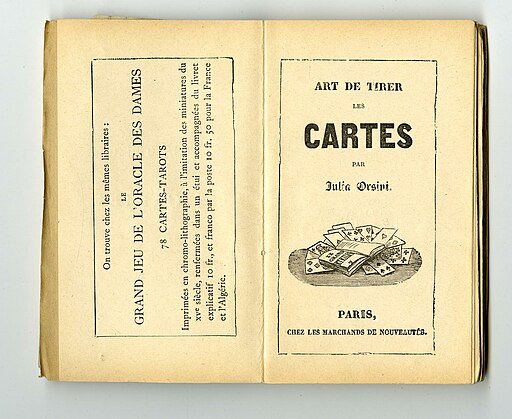
Complete tarot pack of 78 playing-cards for cartomancy (Etteilla), with Spanish suit-marks, plus a booklet of instruction. The cards are numbered in each corner and framed with a light blue border. Hand-coloured lithograph, letterpress Backs printed with a red pattern In original box Early 19th Century (source: wikimedia)

Divinatory Meanings: Etteilla was the first to assign specific divinatory meanings to each card, both in upright and reversed positions. This departure from earlier decks, which had been primarily used for gaming, marked a significant shift toward using tarot cards for fortune-telling and divination.
Card Titles and Keywords: In the Grand Etteilla Tarot, the cards are labeled with descriptive titles and keywords that indicate their divinatory interpretations. These titles and keywords often reflect the card’s symbolism as interpreted by Etteilla.
Influence of Numerology and Astrology: Etteilla incorporated numerology and astrology into his interpretations of the cards. Each card is associated with a specific astrological correspondence and a numerical value, which contribute to its divinatory significance.
Reversed Cards: The Grand Etteilla Tarot was one of the first decks to introduce reversed cards, where the cards are read differently when they appear upside down. This practice added depth and nuance to tarot readings.
Deck Variations: Over time, several versions of the Grand Etteilla Tarot deck were published with variations in card design and interpretation. These decks retained the core concepts introduced by Etteilla but sometimes presented them in slightly different ways.
Historical Significance: The Grand Etteilla Tarot deck holds historical importance as one of the earliest attempts to systematize and formalize tarot divination. It laid the foundation for the development of subsequent tarot reading methods and influenced the creation of future tarot decks.
It’s important to note that while the Grand Etteilla Tarot deck introduced innovative concepts, its interpretations and symbolism differ significantly from more traditional and well-known decks like the Rider-Waite Tarot. The deck may appeal to those interested in exploring the historical evolution of tarot divination and its esoteric roots.