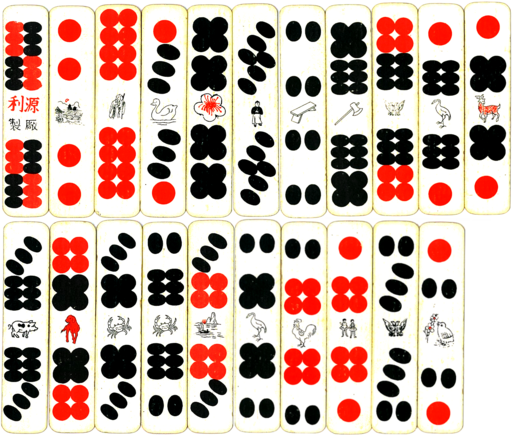
Chinese domino cards. Outlookxp, CC BY-SA 3
Original Chinese Dominoes sets were made of black tiles with red and white dots and also featured duplicates of 11 of the combinations, hence comprising 32 tiles in total. The tiles were also split into suits called “Chinese” and “barbarian”.
source:https://www.biggamehunters.co.uk/pages/history-of-dominoes
What are the first known card games
The exact origins of playing cards are somewhat shrouded in mystery, but we do have records and evidence that point to some of the oldest known card games and their characteristics. It’s important to note that these games were often played with different variations and rules in different cultures and regions. Here are a few examples:
1. Chinese Domino Cards (9th Century): While not exactly playing cards as we know them today, Chinese domino cards are considered some of the earliest precursors to modern playing cards. These cards appeared in China during the Tang Dynasty (9th century). They were rectangular pieces with different patterns or symbols on each side, much like dominoes. The cards were likely used for various games and divination practices.
2. Mamluk Playing Cards (14th Century): These cards originated in Egypt and are among the earliest examples of cards resembling the standard deck we use today. The Mamluk deck had four suits: coins, cups, swords, and polo sticks. Each suit had ten numbered cards and three court cards. These cards had intricate designs and were likely used for both gaming and fortune-telling.
3. Italian Tarot Cards (15th Century): The Italian Tarot cards, which later evolved into tarot decks used for divination, appeared in the 15th century. They were originally created for playing a trick-taking game called Tarocchi. Over time, these cards gained esoteric and symbolic meanings beyond their gaming origins, leading to the development of tarot reading practices.
4. German Playing Cards (15th Century): German-suited playing cards emerged in the late 15th century. The suits included hearts, bells, leaves, and acorns. These cards were often used for trick-taking games and served as the basis for regional card games in Central Europe.
5. Spanish Playing Cards (15th Century): The Spanish-suited playing cards, also dating back to the 15th century, included cups, swords, coins, and clubs. These cards were used for a variety of games, and they influenced the development of playing cards in other regions.
6. Japanese Hanafuda (17th Century): Hanafuda, which means “flower cards” in Japanese, originated in the 17th century. These cards were used in various games and featured beautiful floral and nature-themed designs. Hanafuda cards are still popular in Japan today.
7. French Playing Cards (16th Century): The French-suited playing cards that we are familiar with today—spades, hearts, diamonds, and clubs—emerged in the 16th century. These cards became the basis for many popular card games around the world, such as poker and bridge.
These are just a few examples of the oldest known card games, and they highlight the rich history and cultural diversity of playing cards. Over time, card games evolved and spread across different regions, leading to the wide variety of card games that exist today.