Astrology And Your Birth Chart
In astrology, the planetary position at the time of a person’s birth is believed to have a significant influence on their personality, life events, and overall destiny. This forms the basis of natal astrology, which is the study of a person’s birth chart or horoscope to gain insights into their life, character, and possible events they will encounter in their life.
The birth chart is a celestial map that represents the positions of the Sun, Moon, and all planets at the exact time and location of a person’s birth. The most commonly used planets in astrology are Mercury, Venus, Mars, Jupiter, Saturn, Uranus, Neptune, and Pluto. The Sun and Moon are also considered as luminaries in the birth chart.
Each planet is associated with specific traits, attributes, and archetypal influences. The planet’s position in the zodiac signs and houses of the birth chart provide insight about an individual’s potential strengths, weaknesses, opportunities, and challenges.
What are the parts of a birth chart
Here’s a brief explanation of the main components of a birth chart and their astrological significance:
Zodiac Signs: The zodiac signs represent twelve different archetypal energies, each associated with specific personality traits and characteristics. The position of a planet in a particular sign adds certain qualities to its expression.
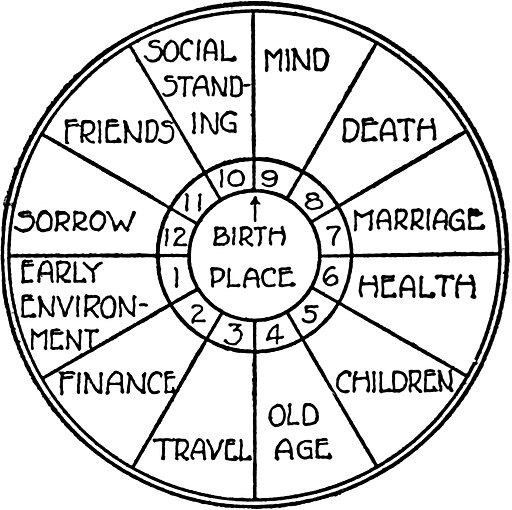
Houses: The birth chart is divided into twelve houses, each representing different areas of life, such as career, relationships, home, etc. The planets’ placement in these houses indicates where their energies are likely to manifest most strongly in a person’s life.
Aspects: Aspects are the geometric angles formed between planets in the birth chart. They indicate the relationships and interactions between the planets, influencing how their energies combine and express themselves in an individual’s life.
The Elements And Astrology
The 12 signs of the Zodiac are separated into 4 elements: Fire, Earth, Air and Water. By examining the different planets in these signs astrologers can draw an in-depth profile analysis of a subject.
Fire: Aries, Leo, Sagittarius. People with fire signs are explosive,volatile, and energetic. They are leaders, inventors and adventurers. Their weaknesses are the tendency of doing their work to their extremes and burning themselves out. The Fire attributes are best to be counterbalanced by Earth signs.
Earth: Taurus, Virgo, Capricorn. People with Earth signs are practical, cautious and reliable. If they are lacking (few Earth signs) they lack imagination and creativity.
Air: Gemini, Libra, Aquarius. Air signs are responsible for intellectual activity, thought and philosophy. People who possess many planets in the Air signs are good planners. Without Air signs, subjects may have difficulty in communication, and be weak in artistic inclination. The excess of planets in Air signs are best to be counterbalanced by planets in the Water signs.
Water: Cancer, Scorpio,Pisces. These are emotional signs. The planets in Water sign moderate the practicality of Earth, the ideas of Air, the careless energy of Fire.
In astrological interpretation, the element analysis is the most traditional. For example, many planets in the Fire sign of a chart is indicative of the subject being very lively and enthusiastic. Though this interpretation is simplistic and direct, astrologers must also consider the effect of the Qualities and Aspects of the subject’s birth chart to draw a complete personality profile.
Interpreting Your Birth Chart
Astrologers interpret the birth chart by analyzing the unique combination of planet positions, zodiac signs, houses, and aspects to provide insights into a person’s personality traits, potential career paths, relationships, and life events. It is essential to note that astrology is considered a belief system and not a scientifically proven discipline, and different astrologers may have varied interpretations based on their expertise and individual approaches.
The birth chart is often seen as a tool for self-awareness and personal growth, allowing individuals to gain a deeper understanding of themselves and their life’s potential trajectory. Many people consult astrologers for guidance and to seek answers about various aspects of their lives, but it is important to remember that astrology should not be used as a substitute for critical decision-making or professional advice.
Is Astrology Accurate?
Astrology can be extremely accurate. But, it is only as accurate as your birth time, which is used to calculate not only the planetary positions, but also your Ascendant (Rising Sign), to the exact degree and minute. That calculation then determines the degree on the Midheaven and all of the house cusps. The cusps then determine in which house your planets will fall. Without an accurate birth time, interpretations and forecasts are invariably incorrect. All of this information is then used in interpreting your personality, determining your career choices, comparing and contrasting your chart with those of other people you know, and forecasting events in your life.
What you need to create your Birth Chart
Before you schedule a consultation or order charts and reports, you should obtain a copy of your birth certificate. If you do not have a birth certificate, if the time is not stated on yours, if you suspect your birth certificate is in error, or if you have only an estimated birth time, you can have your chart rectified (see next section).
But what about your birth certificate? How accurate is it? It may not be as accurate as you think. It’s not hard to get the date and the place correct, but birth times are an entirely different story. Since doctors and nurses are not usually astrologers, they give little attention to the exact time of birth. For example, they may round off an 8:38 birth time to 8:40 or 8:35. A doctor may fill out the birth certificate later on and use an estimated birth time that could be far earlier or later than the true time of birth, or then the time recorded on the delivery room records.
Depending on where and when you were born, your birth certificate may not even have a space for the time of birth. Some people have no written birth certificates at all because they were born at home, or during times when birth certificates were not considered necessary, or in countries where birth certificates are or were not issued. Some parts of the United States have other problems with birth certificate times. For example, during certain years in the state of Illinois, War Time, the precursor to our modern Daylight Savings Time, was in effect but was not observed by all hospitals, many of which continued to operate on Standard Time. That means that if you happen to have been born in Illinois during those times, your birth certificate could be off by an entire hour.
Without an exact birth time, astrology in general, and predictive astrology in particular, are rarely accurate. There may be some general information and interpretations that are correct, but the subtleties and events-oriented aspects will be wrong.