Eight of Swords
Eight of Swords
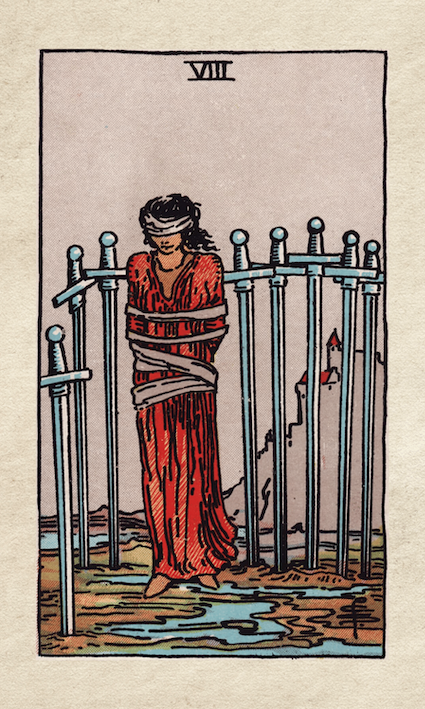
The Eight of Swords depicts a state of mental entrapment and a need for greater self-awareness and objectivity. The card suggests that the person may be feeling helpless and overwhelmed by their thoughts and emotions, but there is an underlying message of empowerment. It encourages the seeker to look within, confront their fears and doubts, and take charge of their own liberation.
Over time, we may not remember why it is that we are afraid, or stuck. The first step is identifying what it is we are really afraid of, even if it isn’t flattering. We must remove the blindfold or bindings that prevents us from seeing or acting. But we must in order to understand what it is we really fear at the core level. Only then can we truly address that which we allow to bind us or hold us back.
By recognizing the self-imposed limitations and negative thought patterns, we can take steps to change our perspective, gain clarity, and find a way out of the mental cage we have created for ourselves. The card serves as a reminder that sometimes, our greatest limitations are not external circumstances but rather our own perceptions and beliefs.
Self-Imposed Limitations: This card suggests that the individual feels trapped or restricted by their own thoughts, beliefs, or fears. It symbolizes a state of feeling bound or confined within self-imposed limitations.
External Constraints: The Eight of Swords suggests that the individual may be constrained by external circumstances, relationships, money, or societal expectations. It represents feeling restricted and unable to make choices freely.
Isolation and Vulnerability: This card signifies a sense of isolation and vulnerability, where the individual may feel alone in facing their challenges. It suggests the need for seeking support and reaching out for assistance.
Perceived Threats: This card can also indicate a heightened sense of perceived threats or fears that may be disproportionate to the actual situation. It advises individuals to examine their fears and assess whether they are based on reality or self-imposed limitations.
Negative Self-Talk: The Eight of Swords represents the internal dialogue of self-doubt, negative self-perception, and limiting beliefs that hinder personal growth. It signifies a lack of confidence and an inability to see the possibilities beyond the perceived limitations.
Symbolism
We are using the Rider–Waite Tarot for this analysis. This deck is the most used world-wide and is highly recommended for those starting out with Tarot.
Swords: The Swords in Tarot is linked to the element of Air, representing the mind, intellect, communication, and thought. This suit can signify both positive aspects like clarity, justice, and courage, and negative aspects such as conflict, mental struggle, anxiety, and painful truths. The suit explores the power and pain of wielding the intellect, cutting through illusions, and facing difficult situations head-on
Blindfold and bindings: The symbolism is not at all subtle. The blindfold shows an inability to see or see clearly. The bindings are not tight and appear loose enough to remove. So often when facing personal issues, we cannot see how we are free to make different choices that free us from our perception of bondage.
Water: The subconcious, emotion and intuition. While the card represents feeling trapped by self-imposed limitations, the water at the woman’s feet suggests she can use her emotional and intuitive power to navigate out of her mental prison.
Mountains: Obstacles real or imagined. A feeling of an insurmountable obstacle or a seemingly impossible situation to escape. The card’s deeper meaning, however, is that the ‘mountain’ is a mental construct, and liberation comes from recognizing that the perceived barriers are self-made.
Ground/Earth: The figure stands on solid ground, representing a foundation of safety and security that exists in their external reality. This contrasts sharply with the mental state of feeling trapped, helpless, or restricted.
The ground shows that the figure is not physically trapped or paralyzed. The stable ground offers a place to stand and build from, once the psychological or emotional limitations are overcome. It represents the potential for a new path forward that is based in reality rather than fear.