The High Priestess
The High Priestess
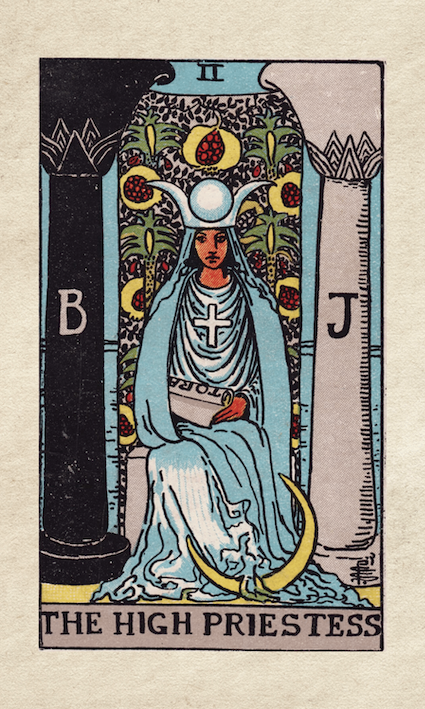
The High Priestess embodies intuition, mystery, and spiritual wisdom. She represents the hidden aspects of the human psyche and the importance of embracing intuition and stillness to access deeper insights and spiritual growth.
The symbolism on the card reinforces the themes of duality, hidden knowledge, and the divine feminine energy.
The High Priestess is deeply connected to her intuition and inner knowing. She trusts her instincts and relies on her inner wisdom to navigate the mysteries of life. She has learned how to listen carefully and to trust her “gut.” She recognizes signs of discord and has learned how to avoid them.
The High Priestess represents intuition and inner wisdom. This card symbolizes the deep connection to the unconscious mind and the ability to access hidden knowledge and insights. It is an invitation to trust one’s instincts and listen to the voice within. The High Priestess challenges you to trust your gut, and to make unpopular choices when it’s in your long-term best interest.
Feminine Energy and the Anima: This card embodies feminine energy and represents the archetype of the Anima. It signifies the intuitive, nurturing, and receptive aspects of the psyche. “The High Priestess” invites individuals to tap into their feminine qualities, such as intuition, empathy, and emotional depth.
Mysticism: This card is associated with esoteric knowledge and spiritual mysteries. The High Priestess encourages seekers to explore the depths of their spirituality and delve into the hidden aspects of existence.
Mysteries and Secrets: This card reflects the mysteries and secrets that lie beneath the surface. It signifies the hidden realms of the unconscious, esoteric knowledge, and spiritual mysteries. “The High Priestess” suggests that there are deeper truths to be discovered and invites individuals to explore the depths of their own psyche.
Balance and Harmony: This card emphasizes the importance of balance and harmony. It represents the integration of opposing forces, such as conscious and unconscious, light and shadow, logic and intuition. “The High Priestess” invites individuals to find equilibrium within themselves and embrace the complementary aspects of their being.
Symbolism
We are using the Rider–Waite Tarot for this analysis. This deck is the most used world-wide and is highly recommended for those starting out with Tarot.
Pillars: The two pillars behind The High Priestess represent duality and the balance between opposing forces. They also signify the gateway to hidden knowledge and the entrance to the mysteries.
Veil: The veil behind The High Priestess represents the boundary between the conscious and subconscious mind. She has access to the hidden realms beyond this veil, emphasizing her connection to the mystical and spiritual.
Crescent Moon: Often seen at her feet, the crescent moon symbolizes the cycles of life, the passage of time, and the connection to feminine energy and the subconscious.
Cross: The cross on her chest symbolizes spiritual and divine knowledge. It represents a connection to the higher realms and a deeper understanding of the mysteries of life. It is also helpful to remember than the general cross shape was used in Egyptian and many other cultures, before it was adopted by the Church.
♦ Egyptian Ankh: The ankh, which resembles a cross with a loop at the top, was a symbol of life and immortality in ancient Egyptian civilization. It was associated with various deities and was often held by gods and pharaohs.
♦ Mesopotamian and Sumerian Cultures: The cross-like symbol appears in Mesopotamian and Sumerian artifacts, where it represented divinity, cosmic order, and the connection between heaven and earth.
♦ Nordic and Celtic Crosses: The Nordic and Celtic cultures used cross-like symbols, such as the Celtic cross, which predate Christianity. These crosses were associated with various spiritual beliefs, representing the four elements, the four directions, or the unity of the spiritual and material realms.
♦ Mesoamerican Crosses: Some Mesoamerican civilizations, like the Maya and Aztecs, had cross-like symbols in their religious and cultural practices. These symbols often represented cardinal points, the four elements, or the cosmos.
Torah Scroll: The Torah scroll she holds is a symbol of ancient wisdom and sacred knowledge. It represents the esoteric teachings that she guards and imparts to those who seek her guidance. The scroll is partially visible to anyone, the other part concealed by her robes.
Pomegranates: Pomegranates are often depicted in the background, representing fertility, abundance, and the hidden potential within us that can be unlocked through introspection and self-discovery.